


Current location:Home > Markets > Nutraceuticals
|
History |
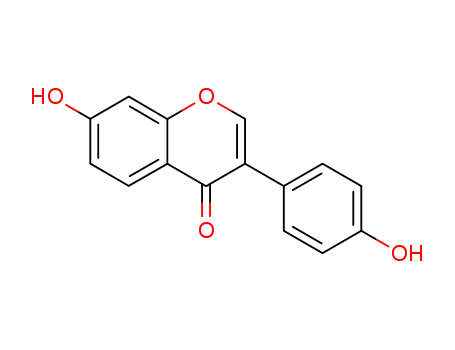
Daidzein is a kind of isoflavone compound, which was first synthetized by researchers in China. It has been widely used in drugs, food supplements, and cosmetics. Because of two phenolic hydroxyl structures, Daidzein has poor water solubility, poor liposolubility, and strong first-pass effect, leading to the low bioavailability of oral absorption, which limits its widely clinical usage. Ipriflavone is a kind of isoflavone modified from Daidzein, which has been used for the treatment of osteoporosis in Japan and some European countries. The effects of a series of amino alkoxy derivatives of ipriflavones on inhibiting the bone absorption were evaluated. The researchers found that 7-amino alkoxy derivative works best. When Daidzein was alkylated or acylated at 7-hydroxyl selectively, the stability was increased, and thus the proliferation of MCF-7 cell was inhibited. |
|
Indications |
Daidzein is mainly used for the treatment of hypertension, coronary heart disease, cerebral thrombosis, and vertigo and aids in the treatment of sudden deafness. It can also treat women with menopause syndrome. |
|
Biological Activity |
Analog of the phytoestrogen genistein (5,7-Dihydroxy-3-(4-hydroxyphenyl)-4H-1-benzopyran-4-one ). Blocks G 1 phase cell cycle progression and is an agonist at estrogen receptors. |
|
Biochem/physiol Actions |
Soy isoflavone daidzein protects against oxidative damage in liver cells induced by 7,12-dimethylbenz[a]anthracene (DMBA). Catalase and superoxide dismutase activity, down-regulated by DMBA, was restored by daidzein. |
|
Pharmacology |
Daidzein has many kinds of pharmacological effects, such as anticancer, cardiovascular protection, estrogen- and antiestrogen-like effects, antiosteoporosis, antioxidation, improving immunity, and affecting the endocrine system. More attention has been paid by domestic and international pharmaceutical and food industries. Daidzein has obviously antibacterial effect on Staphylococcus aureus and Escherichia coli. It can also increase the weight of immune organs in mice and has anti-arrhythmic effect. The chemical structure of daidzein is very similar to the endogenous estrogen, so the estrogen-like effect is used to treat menopausal syndrome and increase the levels of osteocalcin (BGP) and also the bone mineral deposits. The clinical efficacy is similar to estrogen replacement therapy (ERT). Daidzein doesn’t induce the high expression of estrogen. It has effects on the osteoblast to reduce the bone absorption of osteoclast, thus maintains the dynamic balance of osteoblast and osteoclast, finally reduces the risk of fracture. So it is safe for usage. Daidzein can also increase the bone mineral density (BMD) and bone mineral content (BMC) of the lumbar spine, the number of trabecular bone, and bone volume fraction, improve the bone microstructure, and thus prevent the reduction of femur biomechanics in glucocorticoid-induced osteoporosis in the rat. Daidzein has an anti-hypoxia effect. The study showed that Daidzein could significantly prolong the survival time of mice in hypoxia tolerance test under normal pressure and after subcutaneous injection of isoproterenol, suggesting that Daidzein has the significant anti-hypoxia effects. Daidzein plays a protective role in myocardial hypertrophy induced by isoproterenol in rat probably by the antioxidative effects. Similarly, Daidzein may protect the ischemia-reperfusion injury in rats by increasing the antioxidative capacity. Daidzein can significantly inhibit the proliferation of two human breast cancer cells (MCF-7 and MDA-MB-231) in?vitro with the significant dose-dependent and time-dependent effects. Daidzein can markedly decrease the colony-forming ability, suggesting that Daidzein may have the effect of preventing and treating breast cancer. It was found that Daidzein has the obviously preventive effect on chloroforminduced ventricular fibrillation in mice, therapeutic effect on aconitine-induced arrhythmia in rats, as well as protective effect on the adrenaline-induced arrhythmia in rabbit. Daidzein can significantly reduce the action potential amplitude of sciatic nerve in toad in?vitro. All of the above effects were obviously dose-dependent, suggesting Daidzein has the significant anti-arrhythmic effects |
|
Physical properties |
Appearance: pale-yellow prismatic crystal. Melting point: 315–323?°C. Solubility: soluble in ethanol and ether |
|
Definition |
ChEBI: A member of the class of 7-hydroxyisoflavones that is 7-hydroxyisoflavone substituted by an additional hydroxy group at position 4'. |
|
General Description |
Daidzein is an endocrine-active estrogenic isoflavone. This phytoestrogen is capable to bind to estrogen to exert estrogenic effects in vivo. It can naturally be found in soybean seed and flour. |
InChI:InChI=1/C15H10O4/c16-10-6-4-9(5-7-10)11-8-19-13-3-1-2-12(17)14(13)15(11)18/h1-8,16-17H
-
2-Hydroxyisoflavanone dehydratase, which...
The reaction mechanism of oxidative rear...
Daidzein, which is scarce in nature, has...
A set of isoflavononid and flavonoid ana...
Isoflavones were synthesized from the re...
In this study, polyhydroxyisoflavones th...
The invention discloses a water-in-oil s...
Solgen 40


daidzein

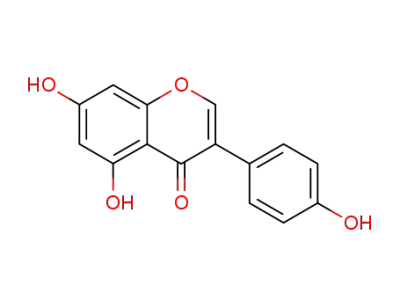
5,7-Dihydroxy-3-(4-hydroxy-phenyl)-chromen-4-on
| Conditions | Yield |
|---|---|
|
Solgen 40;
With
hydrogenchloride;
In
methanol; water;
at 20 ℃;
for 41h;
Heating / reflux;
With
sodium hydroxide;
In
water;
at 20 ℃;
for 0.5h;
|
ADM Novasoy
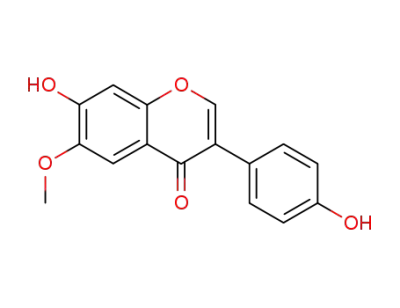
glycitein
daidzein
5,7-Dihydroxy-3-(4-hydroxy-phenyl)-chromen-4-on
| Conditions | Yield |
|---|---|
|
With
hydrogenchloride;
In
methanol; water;
at 20 ℃;
for 49h;
Heating / reflux;
|
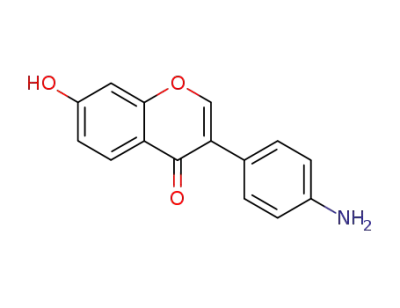
7-hydroxy-3-(4-aminophenyl)-4H-benzopyran-4-one
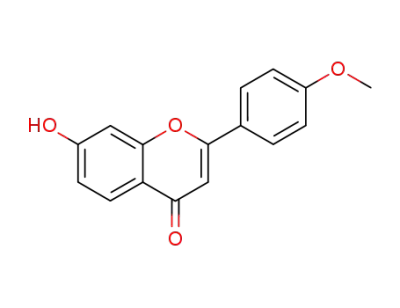
pratol
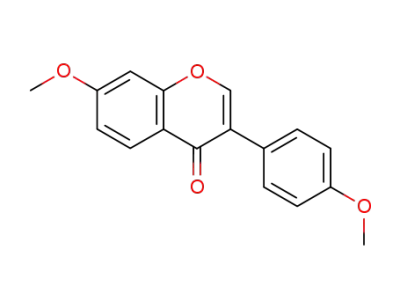
7-methoxy-3-(4-methoxyphenyl)-4H-chromen-4-one
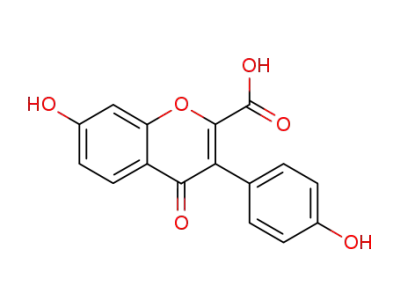
2-Carboxy-7,4'-dihydroxyisoflavone

daidzein diacetate
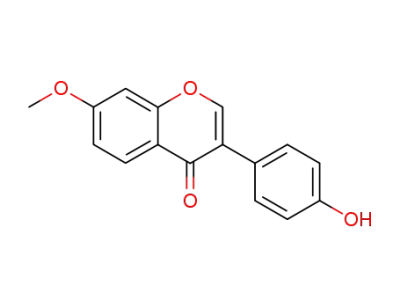
isoformononetin

equol
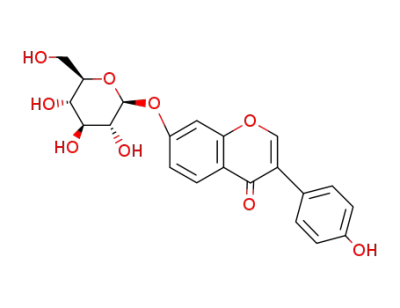
daidzin