Current location:Home > Markets > Nutraceuticals
|
Chemical structure |
Chitin is a naturally occurring polymer consisting of 2-acetamido-2- deoxy-D-glucose via a β(1-4) linkage. Three forms of chitin are available, namely α-, β-, and γ-chitin, however, the structure of α-chitin has been investigated more extensively than that of either the β- or γ- form. Very few studies have been carried out on γ-chitin because γ-chitin may be a distorted version of either α- or β-chitin.Its structure is similar to cellulose but with 2-acetamido-2-deoxy-β-D-glucose (NAG) monomer units. Chitin has limited applications because of its acetyl groups, but through the deacetylation process chitin is converted into chitosan. During the deacetylation process, the acetyl group present in chitin is converted into hydroxyl (-OH) and amino (-NH2) groups in the chitosan. The modification of the reactive functional groups present in chitosan opens the possibility of broad application in many fields. |
|
Source |
Chitin is usually isolated from the exoskeletons of arthropods’ chitin-based tissue (30%-40% protein, 30%-50% calcium carbonate, and 20%-30% chitin), such as crustaceans, mollusks, insects, and certain fungi. It is a biological nanocomposite material strictly hierarchically organized which reveals various structural levels. At the molecular level is the polysaccharide chitin itself. The next structural level is the arrangement of c. 18-25 of such molecules in the form of narrow and long crystalline units, which are wrapped by proteins, forming nanofibrils of about 2-5 nm diameter and about 300 nm length. The next step in the scale consists of the clustering of some of these nanofibrils into long chitin-protein fibers of about 50-300 nm diameter.Chitin is mainly occurs in three different polymeric α-, β-, and γ-forms. The chains are arranged in stacks or sheets in α-chitin and adjacent sheets along the c-axis have the same direction in a parallel arrangement. The α-chitin occurs in the exoskeletons of crustaceans (e.g., crabs, lobsters, and prawns). In the case of β-chitin, the adjacent sheets along the c-axis present in opposite directions in an antiparallel arrangement and it can be found in squid pen, certain diatoms, and vestimentiferans (a class of deep-sea animal). However every third sheet is in the opposite direction to the preceding sheets in γ-chitin. It mainly exists in fungi and yeast. |
|
Preparation |
Chitin (C8H13O5N)n, is derived from the Greek word “chiton,” meaning a coat of mail. It is a natural polysaccharide of β-(1-4)-N-acetyl-D-glucosamine monomers, first identified by the chemist Henri Braconnot in 1811.A suspension of chitin crystallite particles was first prepared by Marchessault et al. in 1959. In this method, 2.5 N hydrochloric acid solution was used to treat purified chitin under reflux for 1 h. After the reflux, the excess acid was separated by a decantation process and then distilled water was added to obtain the suspension. It was observed from their method that the acid-hydrolyzed chitin spontaneously dispersed into rod-like particles that could be concentrated to a liquid crystalline phase and self-assembled to a cholesteric liquid crystalline phase above a certain concentration. Though chitins are present within numerous taxonomic groups, on the commercial scale they are usually extracted from marine crustaceans, mainly because a large amount of waste is available as a by-product of food processing. |
|
applications |
Chitin and its derivative chitosan are natural biopolymers which are extracted from crabs, prawns, and shrimps. Chitin consists of β-(1,4)- linked 2-acetamido-2 deoxy-β-D-glucose which is insoluble in water and hydrophobic in nature.Chitin is a natural biopolymer, which is biocompatible and biodegradable and useful in many applications like biomedical, electronics, photography, and textiles. The main advantages of chitin and its derivates are the low cost and easily availability. The chitin-based composites like chitin beads, chitin nanofibers, and chitin hydrogels are used in drug delivery and tissue engineering applications. In recent times, chitin and its derivates have gained much importance in the field of electronic applications as sensors and energy storage applications. Chitin nanofiber papers are being used as flexible green electronics in solar cells and organic light-emitting diodes. Aksoy et al. prepared low-cost chitin derivatives with high conductivity, for the construction of Schottky diodes, which are useful for photoelectrical applications. Schauer et al. reported a variation of the piezoelectric effect of the chitin electrospun nanofibers. |
|
Definition |
chitin: A polysaccharide comprisingchains of N-acetyl-d-glucosamine,a derivative of glucose. Chitin isstructurally very similar to celluloseand serves to strengthen the supportingstructures of various invertebrates.It also occurs in fungi. |
|
Agricultural Uses |
Chitin is a polysaccharidec omprising chains of N-acetyl- D-glucosamine, a derivative of glucose, linked byβ-1,4 bonds and containing about 77 nitrogen atoms. It may be visualized as cellulose in which the hydroxyl groups on the second carbon are replaced by -NHCOCH3 groups Chitin is structurally very similar to cellulose and serves to strengthen various invertebrates. It offers resistance to chemicals and is present in the cell wall of some fungi as well as in the exoskeleton of insects. |
InChI:InChI=1/C28H49N3O16/c1-11(35)29-21-19(9-44-8-15-17(5-33)47-28(42)23(25(15)39)31-13(3)37)45-16(4-32)14(24(21)38)7-43-10-20-22(30-12(2)36)27(41)26(40)18(6-34)46-20/h14-28,32-34,38-42H,4-10H2,1-3H3,(H,29,35)(H,30,36)(H,31,37)/t14-,15-,16?,17?,18?,19+,20+,21?,22?,23?,24+,25+,26-,27-,28-/m1/s1
A method of resolving a mixture of stere...
Disclosed are x-ray contrast composition...
Disclosed are x-ray contrast composition...
Controlled release pesticide-polymers ar...

chitin
| Conditions | Yield |
|---|---|
|
|
|
|
|
|
|
|
|
|
|
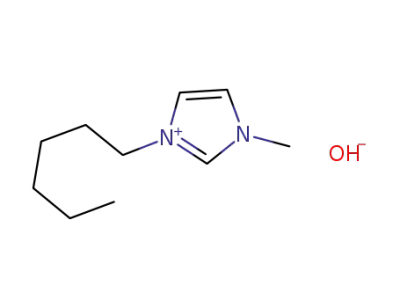
1-hexyl-3-methylimidazolium hydroxide

chitin
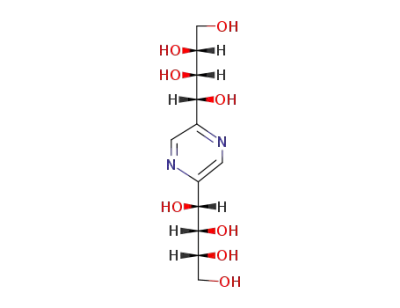
(1R,1'R,2S,2'S,3R,3'R)-1,1'-(2,5-pyrazine)-bis-1,2,3,4-butanetetraol
| Conditions | Yield |
|---|---|
|
With
dihydrogen peroxide;
In
water; dimethyl sulfoxide;
at 180 ℃;
for 1h;
|
chitosan
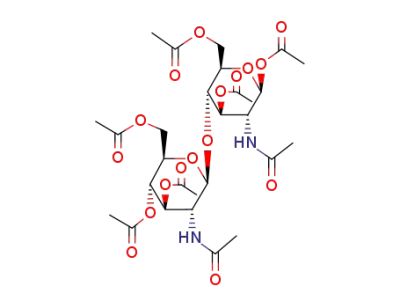
chitobiose octaacetate
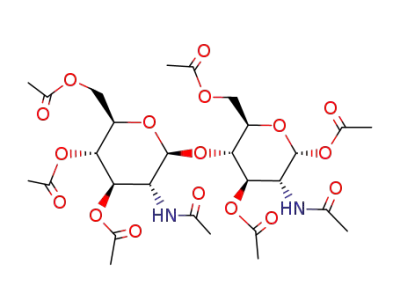
chitobiose octaacetate
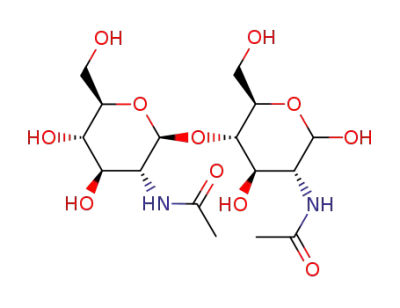
N,N'-diacetylchitobiose